
Prof. Dr. Heidi Helmhold

Without pillows, good mattresses and warm blankets, life would be uncomfortable. I am fascinated by these media because I have been dealing with aching muscles since childhood. At some point during my school days, I started sewing thick, fluffy blankets to pamper my body.
During my philosophy studies, I learned that a distinction can be made between the body and the physical self. We stage our bodies through training, cosmetics, clothing, styling and various performances. We send messages to the outside world, relate to our counterparts, communicate and interact with them. We take our bodies to the doctor and give them prostheses.
But there is another body that is not visible to others: the felt body. It is, in a sense, an interior space that cannot be measured from the outside. It is furnished with our sensations, feelings, emotions, suffering, joy, happiness, boredom, sadness, etc. Only partially visible to others – but perceptible and ever-present to oneself.
The body communicates with us, it hurts, it feels good, it needs relaxation, it needs help. And we serve it according to our needs – we satisfy it with media: beds, sofas, upholstery, cushions – with media that are good for us and our muscular sensations: soft architecture. We serve our bodily needs with these soft spatial media. They are buffer zones between the inside, the body, and the outside, the physical world.
Soft Architecture was published in 2012 by Verlag der Buchhandlung König, Cologne. In it, I describe a different kind of architecture, one that is attuned to the body – media that relax us and that we perceive not with our eyes, but with our skin and muscle reactions.
On this website, I present some agents of this body-affine architecture, show spots of their historical development, supplemented by further essays and projects. However, bodily sensation is also a topic in dealing with illness, which I have been working on for some time and on which I will be posting texts on this site.
Muscular sensations

We live in spaces of built, stable architecture. And within them, we construct further spaces, “soft” architectures. In doing so, we cater to our muscular sensations, which prompt us to place padding between our sensitive bodies and the built architecture. Art historian August Schmarsow spoke of “muscle sensations” in a lecture in Leipzig in 1893, and this term is consistent with the findings of today’s brain research. In the early 1990s, brain researcher Antonio R. Damasio developed connections between “emotional body states”. We now know that there are somatosensory regions of the brain in which sensations from the entire body are received as signals and sent back to the body. (Antonio Damásio, Descartes‘ Error: Emotion, Reason, and the Human Brain, Berlin 2010)
To satisfy this need for muscle sensations, humans (and animals) develop (or seek out) textile counter-architectures as inhabitants. These are upholstery and movement-responsive media in interior and exterior spaces. We buffer, pad, cushion, install. We soften built architecture. In fact, we embed our moods, needs, desires and emotions in textile material. In the modernist project, the interior was cleared out and denounced as the ‘cluttered, dreamless retreat of the bourgeoisie’. (Beate Söntgen, Interieur – Das kritische Potential der Gegenwartskunst, 2005, 365). However, as a place for private, physical self-encounter, this retreat has not been abolished; on the contrary, it increasingly functions as a place of physical experience now that the social body has been delegated to the health-cultural values of fitness.
Upholstery – bed formations, reclining cushions, support cushions, daybeds, lazy beds, soft-sprung sofas, wool blankets – cater to muscle sensations and skin senses. They respond to the slightest changes in body position and adjustments. According to Damasio, it is somatic background sensations that convey to us whether we are feeling well or not. In any case, we pad our living environment and avoid sitting or lying on hard surfaces. In doing so, we create our own soft architectures with our bodies and our muscle sensations.
(from: Heidi Helmhold, Affektpolitik und Raum, Zu einer Architektur des Textilen, Cologne 2012)
The final room
Death cases – On the materiality of mourning culture
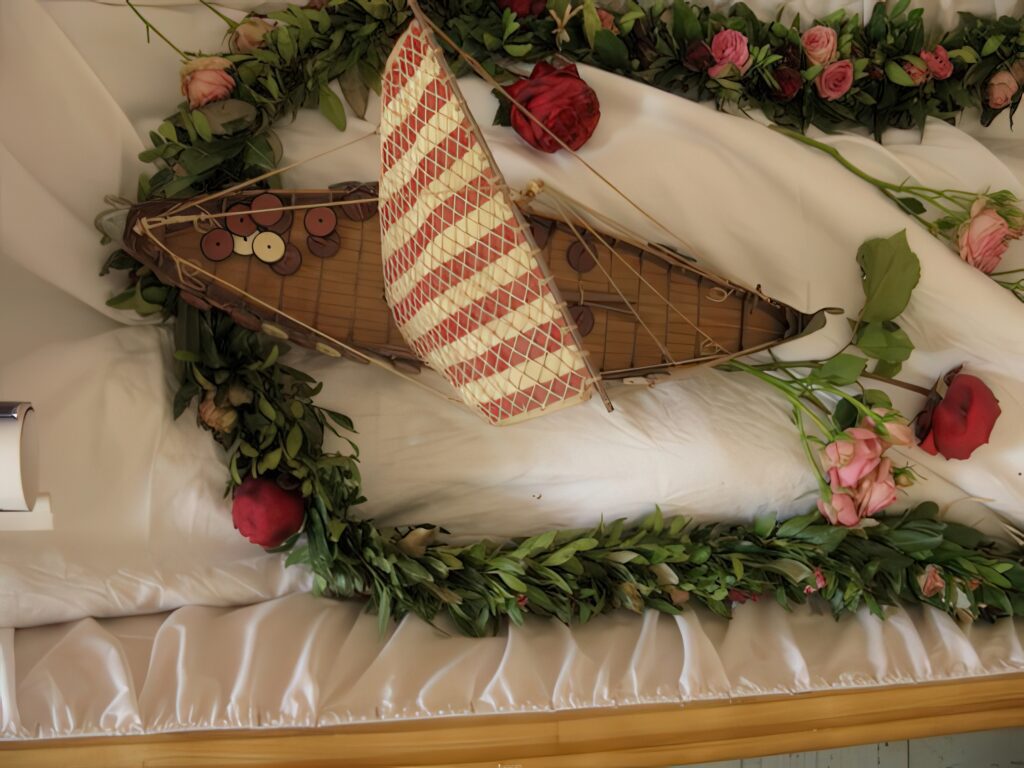
The coffin as the final resting place
The Christian concept of passing away from life as one who has fallen asleep (1 Corinthians 15) involves placing people in a bed-like box – the coffin. The coffin is the ultimate final resting place, usually made of wood, in a few basic coffin-typical shapes, a wooden box 2050 mm long, 750 mm wide and 750 mm high (including feet). In Ghana, coffins are designed in a pop culture style and can sometimes be shaped like a car or a tiger. But in Europe, such ideas would violate cemetery regulations. Coffins are placed in a grave, a second final resting place about two metres below ground.
In the final resting place, we are no longer active participants. As deceased persons, we may have chosen our final resting place, but we can no longer visit it. The dead are passive users of space. They do not enter the grave but are buried. They do not lie down in a coffin but are laid in a coffin. They do not ascend to a higher stage but are laid out on a catafalque – all of which are dignified expressions of spatial reference that ritualise actions over the inaction of a corpse. In this respect, final spaces are those spaces in which actors exist only as their representatives. In memory and remembrance, the dead are reconstructed in their personality, the acting void is transferred into rituals of memory and remembrance.
What does the standardised object culture of a coffin look like? How do people design farewell rituals in Christian religious culture? What fields of action are constructed by means of coffins and coffin furnishings? What does clothing culture do for the bodies of the dead? What images are created in the process? How do mourning cultural performances change when the reference system of nature replaces Christian religion?
See also: Heidi Helmhold, Totenfutterale. Zur Materialität von Trauerkultur (Coffins: On the Materiality of Mourning Culture) in: Manuel Stetter (ed.), Die soziale Präsenz der Toten (The Social Presence of the Dead), Bielefeld:transcript, 2025, pp. 57–76.
Find out more under Publications (2025).